3.7M
acres of Texas working
land lost · 1997–2022
land lost · 1997–2022
3.7 million acres of Texas working land have been converted to non-agricultural use since 1997 — 1.8 million of them in just the last five years. In the same window, $14.6 billion in agricultural production was lost to drought, heat, and wind. The land that still farms is shrinking every week the McKinney metro pushes north.
Texas agriculture has been structurally exposed to weather risk in a way no other state has matched. The losses are not cyclical — they are accelerating, and they are concentrated in the exact failure modes controlled-environment agriculture is built to remove.
"Two out of every three dollars lost on a Texas farm was lost to a variable a greenhouse could have controlled."
McKinney was the fastest-growing city in America in 2024. Every year that growth pushes another ring of working ag land into residential classification — and once a parcel leaves the ag rolls, it does not come back. The corridor 2602 Woodlawn sits in is in the last generation of farmable acres this side of the metro edge.
Each block represents an agricultural parcel in the McKinney / north Collin corridor. Green are still working the land; rust are parcels that left ag classification in the past decade. Gold is 2602 Woodlawn — inside the Agricultural Lifestyle District of the ONE McKinney 2040 plan, still ag-capable, still defensible.
The statute was written for this exact pattern. HB 43 authorizes AgPro grants for maintaining agricultural uses of land — and in the McKinney corridor, that phrase describes a narrow, closing window. Parcels that transition out do not transition back. The grant is for the ones that still can.
In a state where water scarcity caused the largest share of the losses, the question stops being "how do we grow more" and starts being "how do we grow the same with less." Controlled-environment aquaponics is the answer that actually shows up on the water meter.
The open-field baseline to grow 37,000 lbs of leafy greens in North Texas — exposed to the same drought, heat, and wind that drove two-thirds of the $14.6B loss.
The same 37,000 lbs of annual leafy-green output, produced inside a climate-controlled building on recirculated water from the natural spring — weather-independent and auditable on a meter.
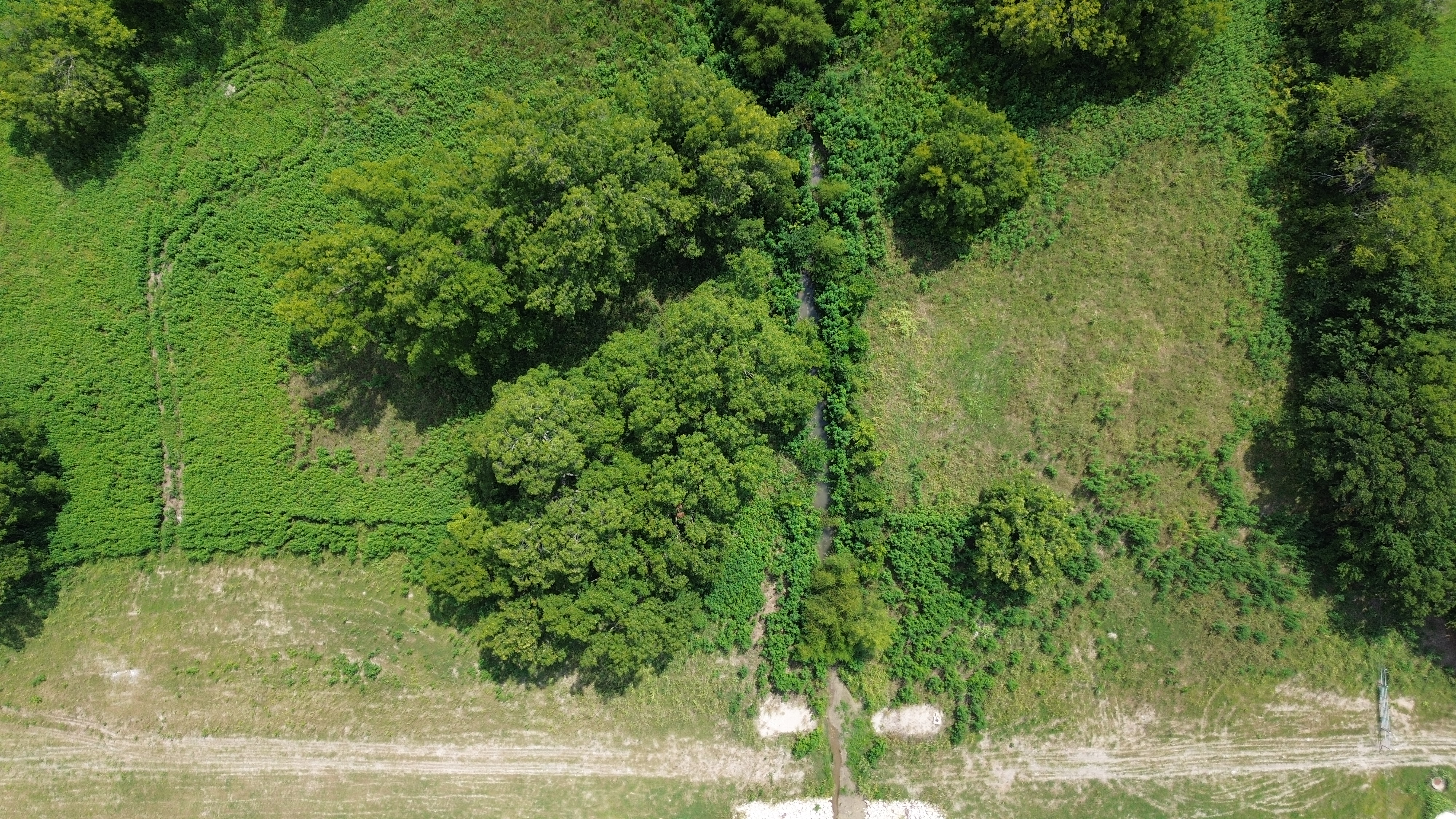
A natural spring feeds the pond from the northeast corner of the parcel, 365 days a year. The water is cool, shaded by mature canopy, and biologically seeded by decades of riparian contact. It is the kind of water source modern controlled-environment operations pay to engineer — and it is already on site.
The spring is the reason 2602 Woodlawn can credibly claim structural water efficiency. The aquaponic loop pulls from a source that does not depend on drought-year allocations. The recirculating design means every gallon works multiple times before it leaves. The difference between 24 acre-feet and 1.2 acre-feet starts here, under the oxbow.
On Collin County's own books, this parcel has no agricultural value. That is the state of the ledger for thousands of acres at the edge of the metro — land that was farmed, reclassified during the development wave, and is now carried as residential even while the ground itself is still capable. The record reflects how the land is zoned, not what it can grow.
The case for keeping land like this in production is not aspirational. It is operational. Every component is specific, measurable, and already represented on working facilities in Texas and elsewhere.
A controlled-environment greenhouse produces leafy greens 365 days a year. Drought, heat, and wind — the three variables that drove two-thirds of the state's losses — stop mattering at the fence line.
Recirculating aquaponics on spring-fed water produces 37,000 lbs of leafy greens annually on roughly 1.2 acre-feet — 95% less than the open-field baseline for the same output.
Fresh produce and protein produced inside the DFW metro reduces North Texas dependence on out-of-state supply chains and shortens the distance between harvest and table to a single delivery window.
The Collin County ag corridor is shrinking on a schedule no one has slowed. The parcels that still have water on-site, canopy, and enough acreage to produce at scale are a dwindling set — and every year fewer of them stay capable of farming at all.
This page exists to make that visible. If the numbers here matter to you, or you want to visit the land, reach out.